

What Happens When a US Mint Coin Sells Out?
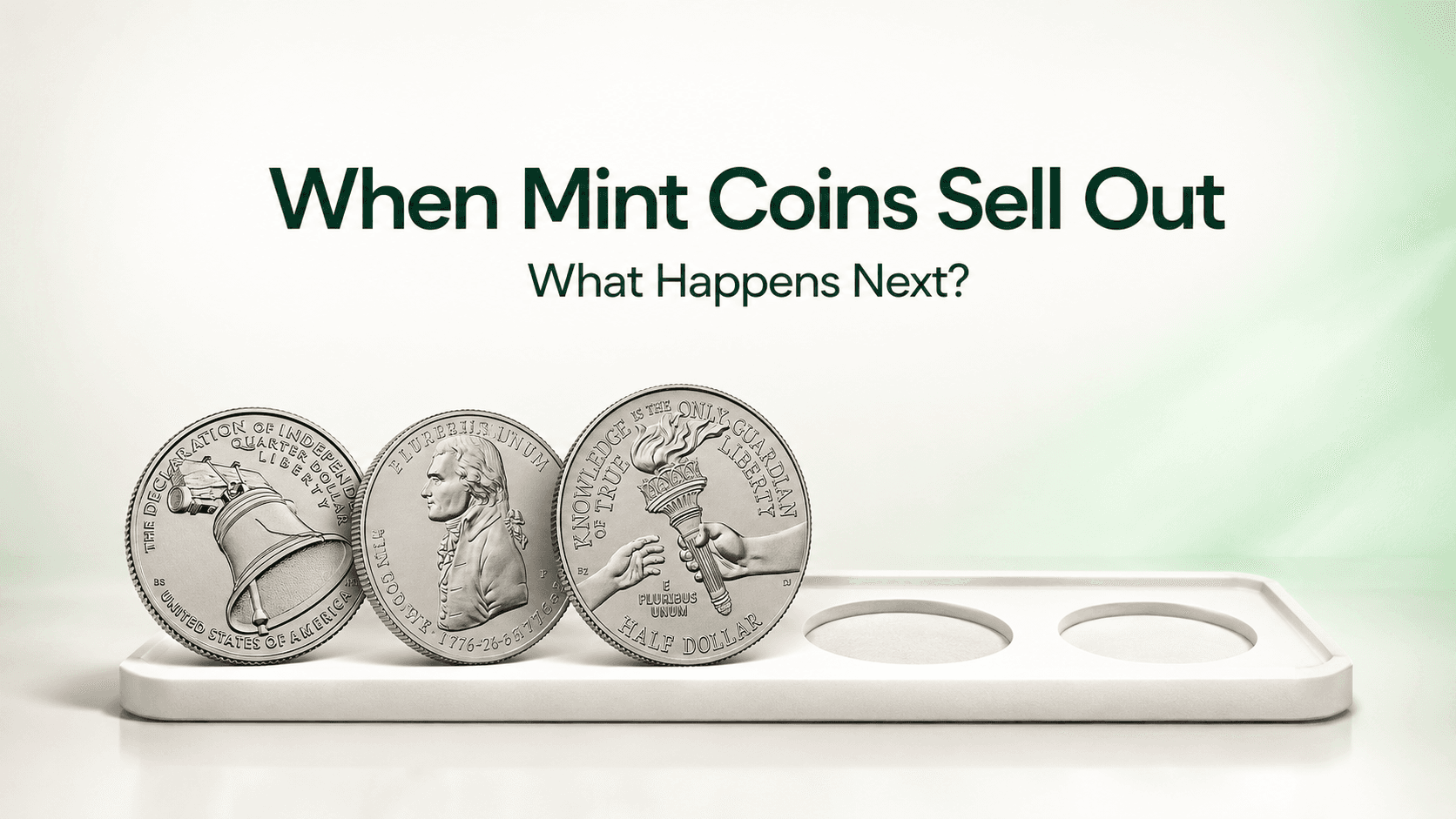

Search for a low-mintage US Mint coin a few hours after release and you'll rarely see the words "sold out." What shows up instead is usually "Currently Unavailable."
The Mint almost never officially declares a numismatic product sold out. It more often lists items as "Currently Unavailable," a label that doesn't necessarily mean sales have ended. Products can and do return to the sales page, sometimes within hours, as canceled orders free up inventory or the Mint authorizes more production against a mintage limit it already announced.
That distinction is live right now. The Mint's 250th-anniversary coin program has produced a string of these situations through 2025 and 2026, and the Freedom Ringing Liberty Bell gold coins and silver medal, capped at 2,026 pieces each with a one-per-household limit, go on sale July 16.
Sold out, unavailable, or just paused
Three different things get called "sold out," and they behave differently.
A true sellout is when the Mint hits a fixed mintage limit and stops production for good. Once that number is struck, no more of that specific coin will ever exist.
Temporary unavailability happens often. The 2026-W Proof American Silver Eagle and the 2026 Congratulations Set both disappeared from sale within minutes of their February 26 launch, and the Mint later confirmed it was striking additional units against mintage limits it had already published for both.
Then there's the coin that comes back more than once. The 2026 Semiquincentennial Silver Proof Set launched June 11 at $245, sold 261,516 units almost immediately, and went unavailable. It returned to sale July 1. Five days later, sales had settled at 213,787, a step down from the opening rush, against a mintage limit the Mint had by then raised to 271,250 from an original 250,520.
"Unavailable" doesn't say which of those three situations you're looking at. Watch the product page for the specific coin, or check whether anyone selling it already has units to spare.
Why some coins get capped at all
Circulating coins don't sell out. The Mint keeps striking quarters and dimes for commerce as long as there's demand for pocket change, which is why the 2026 quarters honoring the Declaration of Independence and the Revolutionary War will show up in circulation for years.
Numismatic and commemorative products work on a different rule: a fixed mintage or product limit, often paired with a household order limit that caps how many any single buyer can claim. The 250th Anniversary Army silver proof eagle is a clean example. Mintage capped at 100,000. Orders limited to three coins per household for the first 24 hours. Priced at $105. It went unavailable within a few hours of its June 13, 2025 launch.
The Liberty Bell coins and medal follow the same pattern at a much smaller scale, 2,026 pieces of each product, one per household. They were also hand-loaded and struck in the Philadelphia Mint's Research and Development Lab, a production detail that fits a run this small. Nobody knows yet whether or how fast this specific release goes unavailable. When it does, the process that follows looks like every other capped numismatic release before it.
Once a coin leaves the Mint, ownership just changes hands
A capped coin doesn't disappear when the product page goes unavailable. Every unit already sold is sitting in a collection, a dealer's inventory, or a box in transit. Getting one after that point means finding a person willing to sell it.
That's the secondary market: buying and selling once the original source has stopped taking new orders. Collectors sell to other collectors. Dealers buy from one side and resell to the other. Marketplaces exist to match the two without either side chasing down a stranger on a forum.
What actually sets the price once a coin sells out
A coin's price at the Mint already covers more than the metal in it: the proof finish, the packaging, the mintage exclusivity, sometimes a design premium for something unusual like a non-round strike. Once that coin trades on the secondary market, none of that original math applies anymore. The price becomes whatever a buyer will pay a seller right now, and it moves independently of what the Mint originally charged.
The Semiquincentennial Silver Proof Set shows the mechanic clearly. At its $245 issue price, complete sets have recently sold on eBay for $310 to $349.95, averaging around $326, a premium of roughly $81, or about 33%, over what the Mint charged. Individual pieces inside the set have traded even higher relative to their share of that $245: the proof Lincoln cent alone has averaged close to $128 in separate sales.
That gap can just as easily close or reverse. A coin trades below its issue price when collector interest cools or a newer release pulls attention elsewhere, and there's no formula that ties a secondary price back to what the Mint originally asked. Grade, certification, and completeness (a full set versus loose pieces) all move the number too.
This is a different mechanic than the premium bullion buyers pay over spot price, which tracks the metal itself rather than a mintage cap. Our explainer on bullion premiums covers that side; a sold-out numismatic coin is answering a different pricing question entirely.
A dealer's price tag versus an order book
A single dealer posts one number, an offer to sell at a certain price or buy at another, and that's the deal on the table. You don't see what anyone else is paying, and you can't act on the market itself, only on that one dealer's read of it.
An order book works differently. Pure runs its marketplace this way: instead of one posted price, you see the highest price a buyer currently wants to pay and the lowest price a seller currently wants to accept, side by side, and you can transact against either one instead of negotiating blind with a single shop. Selling works the same way in reverse, covered in our guide to listing on Pure.
That structure shows what the market is doing right now, real bids and asks from real participants, rather than a single shop's asking price standing in for the whole market.
Where the current 250th-anniversary sellouts are trading
Several pieces from this program are already past the Mint and into secondary trading. The Army eagle, along with the Navy and Marine Corps versions, went unavailable shortly after their own launches. The Semiquincentennial Silver Proof Set has cycled between unavailable and available twice already. All of them are listed on Pure's marketplace alongside live bids and asks.
The Liberty Bell coins and medal join that list the moment the Mint's own allocation runs out, whatever day that turns out to be. For the specific release, pricing, and how to buy or sell it, see our Liberty Bell buyer and seller guide.
FAQ
Does "Currently Unavailable" mean a US Mint coin is gone for good?
Not always. It's the Mint's default label, and it covers everything from a genuine end of production to a pause of a few hours while more units get struck against a limit the Mint already published. Check the product page or recent coverage for the specific coin; the label by itself won't tell you which one it is.
Why would a coin sell for more on the secondary market than the Mint charged?
Because the Mint's price and a secondary-market price are answering different questions. The Mint's number reflects production cost and its own built-in numismatic premium. A collector or dealer prices against how many exist and how many people want one right now, which has no reason to land anywhere near what the Mint originally charged.
Is a coin selling above its issue price a sign it's a good investment?
No. A secondary-market price is a snapshot of demand at one moment. Nobody can tell you what a specific coin will be worth later.
How is an order book different from buying at a dealer's price?
A dealer posts one number and that's the deal. An order book shows every live bid and ask at once, so what you see is the whole market's current activity instead of a single shop's price, and you can act on either side of it directly.
---
Ready to see how a sold-out piece from this program is trading? Browse live listings on Pure's marketplace, or read the Liberty Bell buyer and seller guide for the release everyone's watching next.