

Buying Gold and Silver in Europe: How VAT Changes the Price
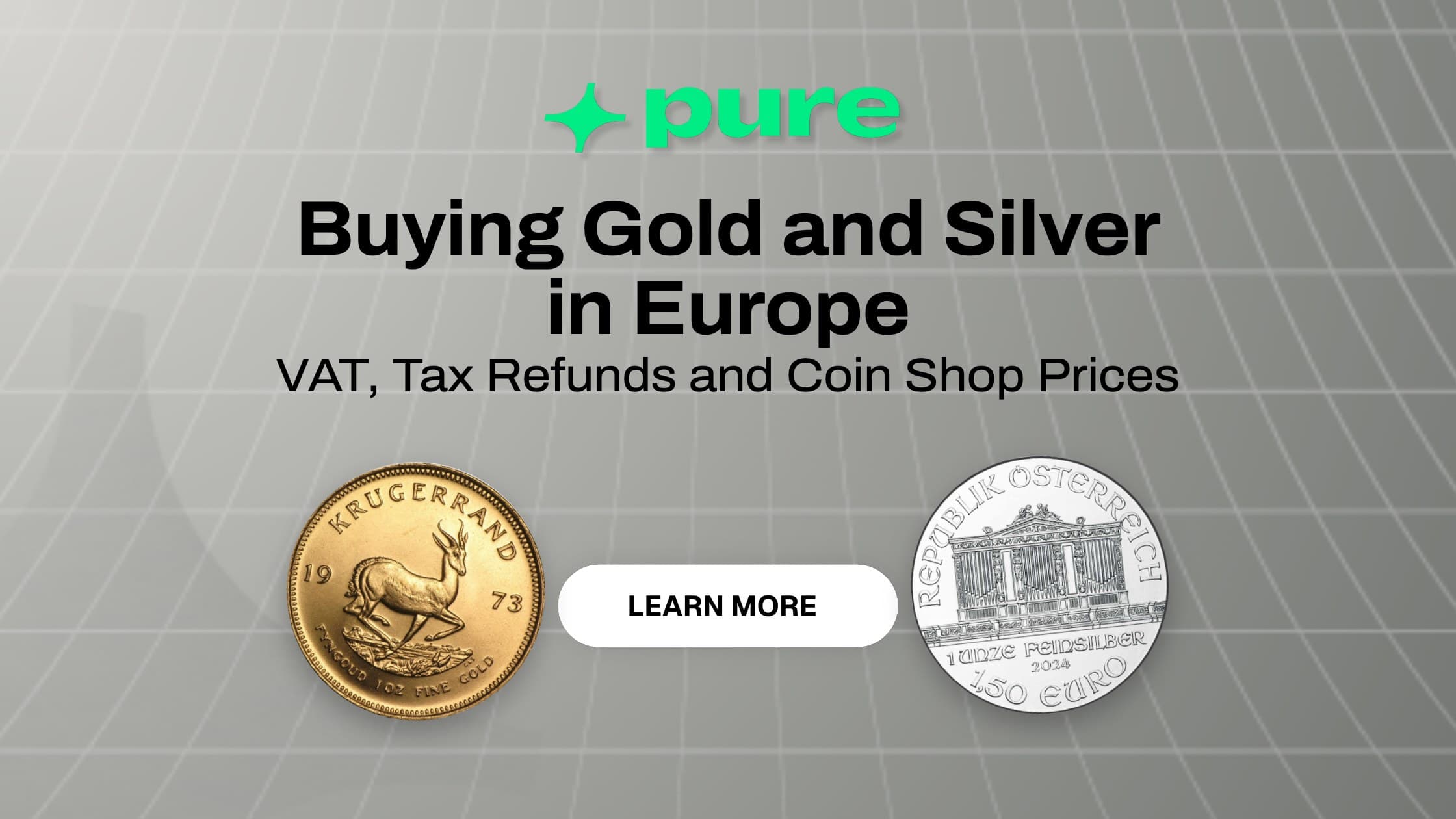

Buy a 1 oz Krugerrand in Paris and there's no VAT on it, because EU law exempts bullion gold. A silver Philharmonic from the same counter is another matter. A new silver coin in a European shop pays the country's full VAT rate, 19% in Germany and 20% in France, and that tax is already built into the price on the shelf.
Gold jewelry is taxed too. The dealer's premium is up to the shop. The tax part follows written rules, and that's what this covers.
Bullion gold is VAT-free in the EU
The exemption has a name in EU law, "investment gold," and no member state is allowed to tax it. What counts is spelled out in the VAT Directive:
Bars and wafers at least 99.5% pure, in weights the bullion market trades. A country can choose to tax bars of a gram or less.
Coins need to be at least 90% gold and minted after 1800. They must be legal tender where they were issued, or have been once, and they normally sell for no more than 80% above their gold value.
On purity and legal tender, the usual bullion coins pass: Krugerrand, Maple Leaf, Philharmonic, American Gold Eagle. The European Commission also puts out a list of qualifying coins each year. If a coin is on it, it counts.
A rare gold coin selling far above its metal value doesn't qualify, and gold jewelry never does.
Silver, platinum and palladium pay full VAT
Nothing like the gold exemption exists for the other three metals. A new silver coin is taxed at the standard rate, the same as a coffee machine. In some EU countries, secondhand coins can be sold under the margin scheme, which taxes only the dealer's markup, so the details vary by shop. Standard rates in ten popular countries, per the EU's Your Europe rates page as of July 2026:
Country | Standard VAT |
|---|---|
Germany | 19% |
France | 20% |
Austria | 20% |
Spain | 21% |
Netherlands | 21% |
Belgium | 21% |
Italy | 22% |
Ireland | 23% |
Portugal | 23% |
Greece | 24% |
Collectible coins can get a lower rate
EU countries are allowed to apply a reduced rate to collectors' items, and Germany is a good example of how narrow that is. Its 7% rate for coins only kicks in when the price is more than 250% of the coin's metal value. That covers numismatic pieces. A bullion coin never gets there.
Gold jewelry is taxed like anything else
A lot of the searches for gold in Italy are about jewelry, and jewelry doesn't get the gold exemption. An 18k chain on the Ponte Vecchio includes Italy's 22% VAT in its price, along with the metal and the goldsmith's work.
Whether that's a good price depends on the piece and the shop. The rules do give a visitor from outside the EU a way to reclaim the VAT. More on that below.
Back home, gold jewelry counts toward your $800 personal exemption, and anything over it is dutiable: CBP charges a flat rate on the first $1,000 over the exemption and the tariff rate after that. Bullion coins and bars come in duty-free, although they still have to be declared. Our guide to flying with gold covers the US Customs side.
Getting VAT back as an American visitor
If you live outside the EU, you can reclaim VAT on goods you carry home, under Article 147 of the same directive. The conditions:
The goods leave the EU by the end of the third month after the month you bought them.
Customs at your last EU exit point stamps the refund form or invoice.
Your purchase meets that country's minimum. The EU caps that minimum at €175, and countries can go lower: France asks for more than €100 at one shop, across no more than three days.
The EU says the process itself isn't harmonized, and each country runs it differently. In France, the shop doesn't have to offer it, and French customs says so plainly. A small coin dealer anywhere may not handle tax-free paperwork at all. Ask before you pay.
French customs also says a purchase can count as commercial from the very first item. A roll of 20 silver coins can look more like stock than a souvenir, and that's customs' call, not yours.
Qualifying gold has no VAT to reclaim, since none was charged.
The UK and Switzerland do it differently
United Kingdom. Gold works the same way. HMRC's gold notice exempts qualifying bars and coins, and its coin test, 180% of gold value, is the EU's 80% rule written another way. Silver pays the 20% standard rate. The big difference is refunds. Great Britain ended tax-free shopping for visitors at the end of 2020, so a silver Britannia bought in a London shop and carried home keeps its VAT. Northern Ireland still runs a refund scheme.
Switzerland. Not in the EU, with its own law. VAT is 8.1%. Gold coins and fine gold bars are exempt there too, but the Swiss coin test runs off customs tariff codes instead of the EU's purity-and-price rules. Only gold is named.
Leaving Europe with it
The EU treats gold as cash at the border. Leaving with €10,000 or more? You have to declare it, and under Regulation 2018/1672 gold counts toward that total: coins of at least 90% gold, bars of at least 99.5%. It doesn't take many 1 oz coins to get there. Silver isn't covered.
Great Britain's £10,000 cash rule doesn't list gold. Northern Ireland's does.
Then you land in the US and declare it all again. That part is in our guide to flying with gold.
Buying at home
If you'd rather skip the paperwork, you can buy on Pure and have it shipped to your US address. Buyers and sellers post their own prices and every order is visible, so you can see what a coin is listed at before you commit. Buyers pay no marketplace fee, we test every item ourselves, and every order ships insured. See what's listed.
Common questions
Is gold cheaper in Italy?
For coins and bars, Italy works like the rest of the EU: qualifying gold carries no VAT, so what you pay over the metal is the dealer's premium. Jewelry is where VAT shows up. It's 22% in Italy, and a visitor from outside the EU can reclaim it if the shop does tax-free paperwork.
Is there VAT on silver coins in Europe?
Yes. New silver coins pay the standard rate, 19% to 24% in the ten countries listed above. In some countries a secondhand coin can be sold under the margin scheme instead, which taxes only the dealer's markup.
Can I get a VAT refund on silver coins?
Often, if you live outside the EU. The shop has to offer tax-free forms, the purchase has to meet that country's minimum, the coins have to leave the EU by the end of the third month after you bought them, and customs has to stamp the form. A large quantity can be treated as commercial and refused. Great Britain no longer refunds VAT to visitors; Northern Ireland still does.